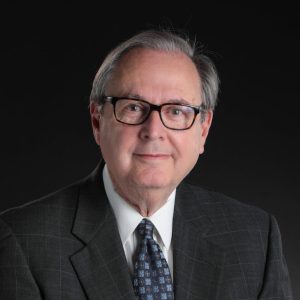
Steve Miller became Executive Director of the Louisville Jefferson County Riverport Authority in August 2024. Throughout his career, he has held essential roles in public policy, politics, and non-profit organizations at the national, state, and local levels.
For 17 years, Steve was CEO of the American Coalition for Clean Coal Electricity, a national non-profit association, and its predecessor organizations in Washington, DC. ACCCE was comprised of major railroads, utilities, coal producers, barge companies, and businesses that support the coal-based electricity industry. Its mission was to promote the use of coal in providing affordable, reliable electricity and advocate for investments in advanced clean coal technologies. During his tenure, Steve built ACCCE from an organization focused on government relations in fewer than ten states to an expanded scope in more than 30 states, federal government relations, and a national communications campaign. Under his leadership, the annual budget grew from $3m to $52m. In 2009, the American Association of Political Consultants recognized ACCCE as the national “Public Issue Grand Marketer of the Year” for its integrated communications campaign, consisting of paid, social, and earned media, and a grassroots citizen army.
Steve has embraced leadership roles in electoral politics. He was a prominent staff member in Brereton Jones’ winning campaigns for Kentucky Lt. Governor (1987) and Governor (1991). He was the 1992 Kentucky Organizational Chairman of the Clinton for President Campaign and worked for the campaign’s media consultants to develop paid media strategies across the nation.
Steve is committed to building a better community, serving as Finance Committee Chair of the Transit Authority of River City (TARC) Board and as Strategic Advisor for Economic Development to Louisville Mayor Greenberg. In the latter role, he helped create Growing Louisville Together, the city’s first comprehensive economic development strategic plan in more than a decade, and establish the Louisville Economic Development Alliance (LEDA), the city’s new private-public partnership.
He is a University of Kentucky and UK School of Law graduate where he was initiated into Phi Beta Kappa and Omicron Delta Kappa, a national leadership honorary organization. He has the rare distinction of playing two years on scholarship for the University of Louisville baseball team and holding two degrees from the University of Kentucky.
Steve has visited more than 25 other countries, the 50 states, and each of Kentucky’s 120 counties. He is an avid sports fan, inspired by writing to Alabama football coach Bear Bryant for the first time when he was nine years old. He is a lifelong learner, currently focusing on generative artificial intelligence and behavioral economics. He lives in Louisville with his wife, Pat. They have two sons, Blake and Clarke.